Goodyear, AZ · Pool Service · Published March 2025 · 7 min read
Pool Evaporation or Pool Leak? How to Tell the Difference in a Goodyear Summer
Arizona’s extreme summer heat makes pool evaporation genuinely high. But there is a point where water loss crosses from evaporation to leak territory. This guide shows you how to find that line.
Why this is a harder question in Arizona than anywhere else
In most U.S. markets, losing more than a quarter inch of pool water per day is a reliable indicator of a pool leak. In Goodyear during July and August, losing a quarter inch per day can be entirely normal evaporation. The combination of intense solar radiation, low humidity, high air temperatures, and frequent afternoon and evening wind events makes the Arizona desert one of the highest pool evaporation environments in the country. This means the standard advice for detecting pool leaks doesn’t translate directly to Goodyear conditions.
The stakes are also higher here. Pool water in Arizona is expensive. CAP-sourced water at West Valley utility rates is not cheap per gallon, and all four Goodyear utilities have tiered rate structures that make the upper usage tiers more expensive per gallon than the baseline rate. A pool losing 1,000 extra gallons per week from a leak adds up to the cost of a small car over a few years of undetected water loss. Detecting a leak accurately and promptly is financially meaningful in this market in a way that it is not in lower-cost-water markets.
How much should a Goodyear pool evaporate?
Evaporation from a pool depends on air temperature, humidity, wind speed, solar radiation, and pool surface area. In Goodyear, the evaporation rate changes significantly by season:
In winter (December through February), pool evaporation in Goodyear is relatively modest, typically 1 to 1.5 inches per week from an uncovered pool. In spring (March through May), evaporation increases as temperatures rise and humidity stays low, reaching 1.5 to 2 inches per week by late May. In summer peak (June through August), evaporation from an uncovered Goodyear pool can reach 2 to 3 inches per week or more. Low humidity, high daytime temperatures, intense solar radiation, and afternoon monsoon winds all maximize evaporation rate. In fall (September through November), rates decline from summer peak back toward winter baseline as temperatures moderate.
A pool cover, including a solar cover, reduces evaporation by 30 to 60 percent during the hours it is in place. Pools in areas with wind breaks lose less water than exposed pools. Pools with high sun exposure during afternoon hours lose more than shaded pools. These variables mean there is no single “correct” evaporation rate for all Goodyear pools, which is why a controlled test is more reliable than comparing against a general number.
The bucket test: the only reliable way to separate evaporation from leaks
The bucket test controls for evaporation by measuring it directly and simultaneously with pool water loss, so the two rates can be compared side by side. Here is how to perform it correctly.
Step 1: Fill a 5-gallon plastic bucket with pool water to within about 2 inches of the top. Mark the water level inside the bucket with a piece of tape or a marker.
Step 2: Place the bucket on the first or second step of the pool so it is sitting in pool water and floating slightly. This ensures the bucket water and the pool water experience the same temperature and similar conditions. Mark the pool water level at the edge of the step or on the pool wall at the same time you mark the bucket level.
Step 3: Turn off the pool’s automatic fill valve or float if it has one. Leave the pool pump running normally during the test.
Step 4: Wait 24 hours. Do not add water to the pool during the test, and do not use the pool in ways that would splash water out.
Step 5: Measure the change in water level inside the bucket and compare it to the change in pool water level at the mark you made on the step or wall.
Interpreting the results: If the pool water level dropped the same amount as the bucket water level, the loss is evaporation. Both experienced the same evaporative conditions and lost the same amount. If the pool water level dropped significantly more than the bucket level, the excess loss is coming from a leak, not from evaporation.
A reliable rule of thumb for Goodyear: if the pool loses more than three-eighths of an inch more than the bucket in a 24-hour period, the differential is significant enough to investigate as a potential leak. The bucket test should be repeated on a second day to confirm the finding before calling a leak detection specialist.
Types of pool leaks to know about
Return line and suction line leaks
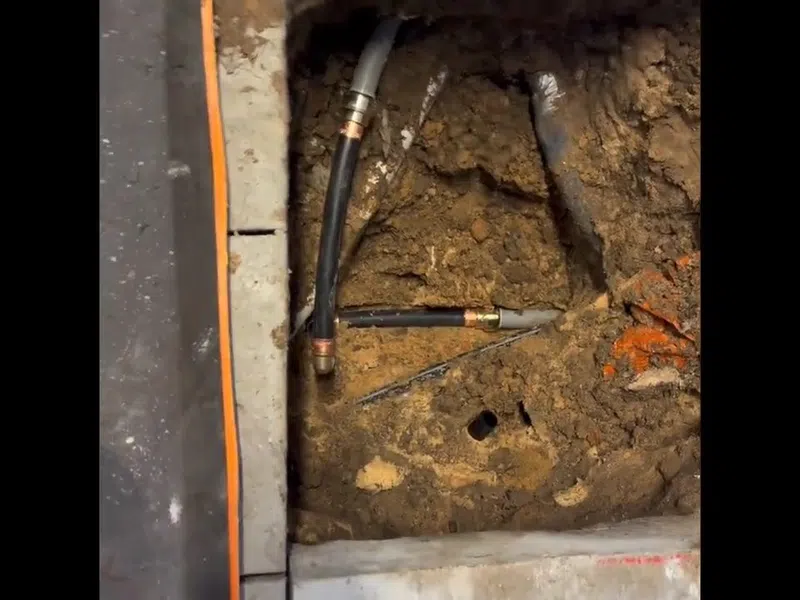
The underground plumbing that carries water from the pool to the equipment pad (suction lines) and returns filtered water to the pool (return lines) runs through the soil under the deck. These buried PVC lines are vulnerable to joint separation from Goodyear’s monsoon soil movement cycle, to thermal expansion and contraction stress, and to tree root intrusion near the pool perimeter. A pressure test of the return and suction lines, performed by closing off each circuit and pressurizing it, confirms whether buried plumbing is holding pressure or losing it. This is the most common type of leak we detect in Goodyear pools.
Skimmer leaks
The skimmer body is cast into the pool shell at water line level. In Goodyear, sustained UV exposure and thermal cycling can cause the plastic skimmer body to separate slightly from the surrounding pool shell, creating a gap that allows water to escape. A dye test at the skimmer throat, performed by placing a small amount of dye near the gap while watching for the dye to be drawn outward, confirms whether the skimmer is losing water. Skimmer leaks typically produce a consistent daily loss rather than a variable one, since the gap is a fixed size and the water level at that point determines how much escapes.
Shell and structural leaks
Concrete pool shells can develop cracks from soil settlement, ground movement, or age-related shrinkage. In Goodyear, where the alluvial soil moves measurably between wet (monsoon) and dry (winter) periods, pools that are 15 or more years old are more likely to have developed minor shell movement. Shell leaks are confirmed with dye testing and sonar scanning of the pool floor and walls, and repaired by injecting underwater sealant into confirmed crack locations.
Equipment pad plumbing leaks
The plumbing connections at the equipment pad, between the pump, filter, heater, and related components, are above-ground and visible. A slow drip at a fitting, valve, or union joint is often visible as a wet mark or salt deposit around the fitting. Equipment pad leaks are the easiest to locate and the least expensive to repair, since access is straightforward. If you see wet areas at the equipment pad, this is a good starting point for investigation before running the bucket test.
When to call a pool leak specialist
If the bucket test confirms a differential loss that exceeds normal evaporation, or if you are adding water to the pool at a rate that seems inconsistent with the season and weather conditions, call us to schedule a pool leak detection appointment. We perform pressure testing on all plumbing circuits, dye testing at suspect locations, and sonar scanning of the pool shell as needed to locate the source.
We find that waiting to call costs more than acting promptly. A pool losing 1,000 gallons per week costs several hundred dollars per month at West Valley water rates, and the underlying cause rarely resolves on its own. Early detection typically means a smaller, more localized repair rather than finding the problem after months of water loss have eroded or saturated the surrounding soil. See our pool leak detection and repair page for the full detection process.
Pool leak questions
What is a reasonable amount of water to add to a Goodyear pool each week?
During the peak summer months (June through August), evaporation from a Goodyear pool with no cover can run 2 to 3 inches per week or more under high-wind, low-humidity conditions. Adding 1.5 to 2.5 inches per week to a pool without a solar cover is within the normal evaporation range in Goodyear summer. If you are adding more than 3 inches per week consistently, or if the addition rate is increasing, the bucket test is the appropriate next step to distinguish leak from evaporation.
What types of pool leaks are most common in Goodyear?
Return line leaks below the pool decking are the most common type we detect in Goodyear and West Valley pools. The combination of soil movement from monsoon saturation and drying cycles, along with the thermal expansion and contraction of buried PVC plumbing across Goodyear’s extreme temperature range, produces joint failures and cracks in buried return lines. Skimmer body cracks from sun exposure and deck movement are the second most common. Shell and liner cracks are less common in properly built concrete pools but occur in older pools or pools that have settled.
How much does pool leak detection cost in the West Valley?
Pool leak detection pricing varies by the scope of the investigation and the methods required. Pressure testing of all return and suction lines, dye testing of specific suspect areas, and sonar scanning of the pool shell are each billed separately or as a combined inspection package depending on the situation. We provide a clear scope and cost estimate before beginning detection work. Repair cost after detection depends on the leak type and location — buried return line repairs typically require excavation, while equipment pad plumbing repairs are more accessible.
Schedule pool leak detection in Goodyear
Pressure testing, dye testing, and sonar scanning for West Valley in-ground pools. We find the source before the water bill gets worse.
(623) 323-3182 — Call Now